
Cut manual handoffs by 50 to 70%. Without removing clinical judgment.
RIS, HIS, and PACS-integrated agentic fabric for hospital networks and clinical operations teams. Built to keep clinicians in the decision loop at every gate, not to replace them.
In production at a US tier-1 health system. 200-bed regional network, multi-specialty deployment. Reference shared on a private diligence call.
Clinical workflows fragment across systems that don’t talk.
RIS, HIS, PACS, and EHR systems run in parallel. Information moves through human hands when it should move through integration. Senior clinical staff spend hours on coordination instead of care.
Most healthcare AI fails in deployment because the question is not “does the model work” but “who is accountable when the model is wrong.” Clinical operations teams need systems that keep humans in the decision loop, not systems that try to remove them.
Generic agentic AI tools are built for SaaS workflows, not clinical environments. They don’t understand the audit, escalation, and clinical-responsibility chain that makes healthcare automation viable.
Four capabilities. Built for clinical environments.
- 01
RIS, HIS, PACS Integration
Direct integration with the clinical systems your staff already use. The orchestration layer sits across them, not in front of them.
- 02
Human-in-the-Loop Gates
Every clinical decision routes through clinician signoff. The system can recommend, retrieve, and document, but doesn’t make decisions affecting patient care without human approval.
- 03
Clinical Audit Trail
Every recommendation, decision, and rationale logged. Chain of clinical responsibility intact and reconstructible.
- 04
Adaptive Escalation Routing
Senior clinical staff routed to high-stakes decisions automatically. Junior staff handle structured cases. The system learns escalation patterns over time.
Two measured outcomes from clinical deployment.
- 0150 to 70% fewerManual handoffs across clinical teamsUS health system, multi-specialty deployment
- 0270 to 90% fasterInternal query and triage responseAnchor deployment, single-specialty rollout to network-wide
US tier-1 health system. 200-bed regional network.
Multi-specialty agentic orchestration across radiology, cardiology, and oncology referral coordination. RIS, HIS, and PACS integrated through FHIR and HL7. Twelve-week deployment from kickoff: single-department pilot (radiology referrals) at week 6, full multi-specialty rollout at week 12. Every clinical decision passes through clinician sign-off; the audit trail is reconstructible to the second. Client reference available on a diligence call.
Directional ranges from the anchor deployment and internal benchmarks. Specific numbers shared with qualified buyers on diligence calls. Results vary by workflow, data quality and adoption.
Scoping a clinical AI deployment?
- Reply within 24 hours, often much faster
- Free 30-minute call. No sales script.
- Honest scope and timeline, including when we’re not the right fit
Common questions.
The system, layer by layer.
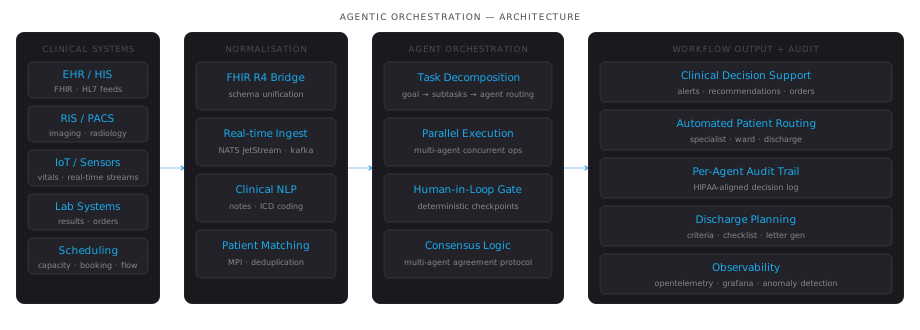
Retrieval Layer
Vector stores indexed for clinical literature and institutional protocols · Embedding models tuned for medical language · Source-grounded retrieval with citation trails
Orchestration Layer
Agentic workflows across RIS, HIS, PACS · Human-in-the-loop gates on every clinical decision · Escalation routing to senior clinical staff · Pre-defined decision authority maps
Compliance Layer
Audit logging at the decision level · HIPAA-aligned access control · Regulator-ready evaluation harnesses · Clinical responsibility chain preservation
Integration Layer
FHIR · HL7 · DICOM · EHR system bridges · Clinical workflow APIs · Lab and imaging system connectors
Deployment Layer
Region-specific hosting · Multi-tenant isolation for hospital networks · Air-gapped options for high-sensitivity deployments
The Orchestration Layer is foundational. Every clinical decision passes through it, and every escalation rule is encoded there.
Senior engineers. Production from day one.